
That post title was basically an oxymoron. Why would anyone need to defend
Enjolras? He's awesome, right?
...Apparently not. I
have heard quite a few people say that they don’t like Enjolras at all.
At first I was just like, "Ha!" But...several of those people made really
good arguments against him, so I decided to write a post defending him. (That's the only reason. Seriously.
I would never write a post simply to fangirl about Enjolras. Got it? Okay, we can go on. :D)

One of the biggest arguments most people seem to have
against Enjolras is that he admires and looks up to Robespierre. Why didn’t he pick Washington or someone like
that?
Three words: Robespierre is French.
Enjolras loved France - and the French Revolution. I don’t know why…keep in mind that a) he
wasn’t alive when the French Revolution happened, and b) perhaps he thought
that the French Revolution had a good beginning
and just needed to be improved on.
That’s my theory, anyway.
Also, perhaps Victor Hugo merely meant that Enjolras’ place
in the June Rebellion was the same as Robespierre’s in the French Revolution-
Enjolras was the instigator, the encourager, the leader.
Besides all that…can you seriously imagine Enjolras trying
to be a dictator like Robespierre?
Really? As far as I know, he
doesn’t particularly hate aristocrats.
He wants everyone to be equal and happy.
It’s basically an impossible
dream, but a noble one.
If Enjolras had really been like Robespierre, he wouldn’t
have tried to send all the people he could out of the barricade. He wouldn’t have tried to trade Jehan’s life
for Javert’s. Robespierre sent his
closest friends and allies to the guillotine; Enjolras shielded them all with
his body as they ran into the wine shop.
Enjolras died a heroic death with Grantaire. (In the movie
and book, anyway. In the musical, he
just dies on the barricades while waving a flag, which is still pretty
awesome.) He forgave Grantaire at the
last. He might have admired Robespierre,
but he was still his own person.

Another thing people don’t like about him is that they say
he’d be infuriating if he lived today.
This is true- a typical conversation with Enjo would probably go
something like this:
YOU: Hi. Want to go
out for lunch?
ENJOLRAS: I’m busy.
YOU: Want to go to the movies?
ENJOLRAS: I’m busy.
YOU: Want to go to the zoo?
ENJOLRAS: Enough talk!
I have a revolution to plan!
…Yeah. He probably
wouldn’t be especially pleasant to talk to.
But even Victor Hugo admitted that.
“One would have liked
to fight under the one [Enjolras] and to march behind the other [Combeferre].”
-Chapter I, “The Friends of the ABC,” Marius, Les Miserables

Enjolras was never interested in social activities or
anything of that sort; he had one purpose and he stuck to it. He was meant to be the leader, not the
friend. He was vulnerable at times, and
he probably needed Combeferre during those times, but during the rest he was
the untouchable guy. The fact that he
wouldn’t be a very nice person to spend time with doesn’t mean he’s not a hero.
“Enjolras was a
charming young man, who was capable of being terrible. He was angelically
handsome. He was a savage Antinous. One would have said, to see the pensive
thoughtfulness of his glance, that he had already, in some previous state of
existence, traversed the revolutionary apocalypse. He possessed the tradition
of it as though he had been a witness. He was acquainted with all the minute
details of the great affair. A pontifical and warlike nature, a singular thing
in a youth. He was an officiating priest and a man of war; from the immediate
point of view, a soldier of the democracy; above the contemporary movement, the
priest of the ideal. His eyes were deep, his lids a little red, his lower lip was
thick and easily became disdainful, his brow was lofty. A great deal of brow in
a face is like a great deal of horizon in a view. Like certain young men at the
beginning of this century and the end of the last, who became illustrious at an
early age, he was endowed with excessive youth, and was as rosy as a young
girl, although subject to hours of pallor. Already a man, he still seemed a
child. His two and twenty years appeared to be but seventeen; he was serious,
it did not seem as though he were aware there was on earth a thing called
woman. He had but one passion--the right; but one thought--to overthrow the
obstacle. On Mount Aventine, he would have been Gracchus; in the Convention, he
would have been Saint-Just. He hardly saw the roses, he ignored spring, he did
not hear the carolling of the birds; the bare throat of Evadne would have moved
him no more than it would have moved Aristogeiton; he, like Harmodius, thought
flowers good for nothing except to conceal the sword. He was severe in his
enjoyments. He chastely dropped his eyes before everything which was not the
Republic. He was the marble lover of liberty. His speech was harshly inspired,
and had the thrill of a hymn. He was subject to unexpected outbursts of soul.
Woe to the love-affair which should have risked itself beside him! If any
grisette of the Place Cambrai or the Rue Saint-Jean-de-Beauvais, seeing that
face of a youth escaped from college, that page's mien, those long, golden
lashes, those blue eyes, that hair billowing in the wind, those rosy cheeks,
those fresh lips, those exquisite teeth, had conceived an appetite for that
complete aurora, and had tried her beauty on Enjolras, an astounding and
terrible glance would have promptly shown her the abyss, and would have taught
her not to confound the mighty cherub of Ezekiel with the gallant Cherubino of
Beaumarchais.”
-Chapter I, “The Friends of the ABC,” Marius, Les Miserables

Enjolras is a really fierce guy. When I first read the brick and listened to
the musical, I didn’t think that he was very true to life. He seemed to be way too perfect. But then I reread the book and listened to
the musical again, and I found Enjolras to be very realistic. He is flawed- his devotion to his cause can
cause him to be callous or even ruthless to other people, and he’s not very
sympathetic about other people’s problems.
If people have a life beyond the revolution, well, too bad for them, in
his opinion.
But…I feel compassion for him too. His family didn’t care much for him and he
never had any use for love. He’s given
up as much as Sir Percy has- and more.
Percy has his wife’s love and the support of his friends- and he has
God. Enjolras has no one. He’s probably never been told of God’s love,
and nobody else has ever loved him. And
yet…instead of being angry and bitter, he focuses all the love inside of him on
his homeland. He focuses on France.
Sir Percy gives up his comfortable home, his reputation and
his safety. Enjolras does exactly the
same. The only difference is that Enjolras
has no one to help him through hard times but Combeferre.

Enjolras gave up everything that he had for his cause,
but he stayed brave and strong up until the last, ready with a smile and a
handshake for anyone who supported him, awing even the soldiers who despised
him.
“At length, by dint of
mounting on each other's backs, aiding themselves with the skeleton of the
staircase, climbing up the walls, clinging to the ceiling, slashing away at the
very brink of the trap-door, the last one who offered resistance, a score of assailants,
soldiers, National Guardsmen, municipal guardsmen, in utter confusion, the
majority disfigured by wounds in the face during that redoubtable ascent,
blinded by blood, furious, rendered savage, made an irruption into the
apartment on the first floor. There they found only one man still on his feet,
Enjolras. Without cartridges, without sword, he had nothing in his hand now but
the barrel of his gun whose stock he had broken over the head of those who were
entering. He had placed the billiard table between his assailants and himself;
he had retreated into the corner of the room, and there, with haughty eye, and
head borne high, with this stump of a weapon in his hand, he was still so
alarming as to speedily create an empty space around him. A cry arose:
"He is the
leader! It was he who slew the artillery-man. It is well that he has placed
himself there. Let him remain there. Let us shoot him down on the spot."
"Shoot me,"
said Enjolras.
And flinging away his
bit of gun-barrel, and folding his arms, he offered his breast.
The audacity of a fine
death always affects men. As soon as Enjolras folded his arms and accepted his
end, the din of strife ceased in the room, and this chaos suddenly stilled into
a sort of sepulchral solemnity. The menacing majesty of Enjolras disarmed and
motionless, appeared to oppress this tumult, and this young man, haughty,
bloody, and charming, who alone had not a wound, who was as indifferent as an
invulnerable being, seemed, by the authority of his tranquil glance, to constrain
this sinister rabble to kill him respectfully. His beauty, at that moment
augmented by his pride, was resplendent, and he was fresh and rosy after the
fearful four and twenty hours which had just elapsed, as though he could no
more be fatigued than wounded. It was of him, possibly, that a witness spoke
afterwards, before the council of war: "There was an insurgent whom I
heard called Apollo." A National Guardsman who had taken aim at Enjolras,
lowered his gun, saying: "It seems to me that I am about to shoot a
flower."
Twelve men formed into
a squad in the corner opposite Enjolras, and silently made ready their guns.
Then a sergeant
shouted:
"Take aim!"
An officer intervened.
"Wait."
And addressing
Enjolras:
"Do you wish to
have your eyes bandaged?"
"No."
"Was it you who
killed the artillery sergeant?"
"Yes."
Grantaire had waked up
a few moments before.
Grantaire, it will be
remembered, had been asleep ever since the preceding evening in the upper room
of the wine-shop, seated on a chair and leaning on the table.
He realized in its
fullest sense the old metaphor of "dead drunk." The hideous potion of
absinthe-porter and alcohol had thrown him into a lethargy. His table being
small, and not suitable for the barricade, he had been left in possession of
it. He was still in the same posture, with his breast bent over the table, his
head lying flat on his arms, surrounded by glasses, beer-jugs and bottles. His
was the overwhelming slumber of the torpid bear and the satiated leech. Nothing
had had any effect upon it, neither the fusillade, nor the cannon-balls, nor
the grape-shot which had made its way through the window into the room where he
was. Nor the tremendous uproar of the assault. He merely replied to the
cannonade, now and then, by a snore. He seemed to be waiting there for a bullet
which should spare him the trouble of waking. Many corpses were strewn around
him; and, at the first glance, there was nothing to distinguish him from those
profound sleepers of death.
Noise does not rouse a
drunken man; silence awakens him. The fall of everything around him only
augmented Grantaire's prostration; the crumbling of all things was his lullaby.
The sort of halt which the tumult underwent in the presence of Enjolras was a
shock to this heavy slumber. It had the effect of a carriage going at full
speed, which suddenly comes to a dead stop. The persons dozing within it wake
up. Grantaire rose to his feet with a start, stretched out his arms, rubbed his
eyes, stared, yawned, and understood.
A fit of drunkenness
reaching its end resembles a curtain which is torn away. One beholds, at a
single glance and as a whole, all that it has concealed. All suddenly presents
itself to the memory; and the drunkard who has known nothing of what has been
taking place during the last twenty-four hours, has no sooner opened his eyes
than he is perfectly informed. Ideas recur to him with abrupt lucidity; the
obliteration of intoxication, a sort of steam which has obscured the brain, is
dissipated, and makes way for the clear and sharply outlined importunity of
realities.
Relegated, as he was,
to one corner, and sheltered behind the billiard-table, the soldiers whose eyes
were fixed on Enjolras, had not even noticed Grantaire, and the sergeant was
preparing to repeat his order: "Take aim!" when all at once, they
heard a strong voice shout beside them:
"Long live the
Republic! I'm one of them."
Grantaire had risen.
The immense gleam of the whole combat which he had missed, and in which he had
had no part, appeared in the brilliant glance of the transfigured drunken man.
He repeated:
"Long live the Republic!" crossed the room with a firm stride and
placed himself in front of the guns beside Enjolras.
"Finish both of
us at one blow," said he.
And turning gently to
Enjolras, he said to him:
"Do you permit
it?"
Enjolras pressed his
hand with a smile.
This smile was not
ended when the report resounded.
Enjolras, pierced by
eight bullets, remained leaning against the wall, as though the balls had
nailed him there. Only, his head was bowed.
Grantaire fell at his
feet, as though struck by a thunderbolt.
-Chapter XXIII, “The War Between Four Walls,” Jean
Valjean, Les Miserables
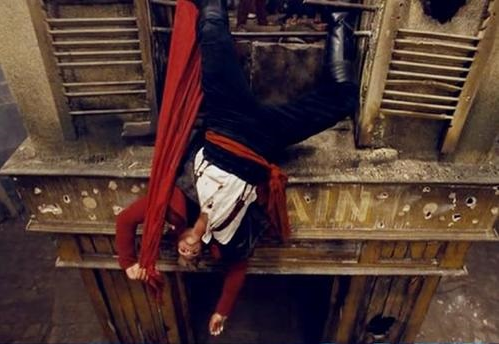
Enjolras lived bravely and died heroically. His life was cold and dark, yet he was unafraid.
That is why I consider Enjolras a hero. He’s not an ideal gentleman like Mr.
Knightley. He’s not a dashing Englishman
with a flippant smile on his lips and purpose in his heart like the Scarlet
Pimpernel. He’s a boy who did the best
he could. In the end, isn’t that what counts?
“They were schoolboys,
never held a gun,
Fighting for a new
world that would rise up like the sun.”
-“Turning,” Les
Miserables

If you're sniffling like me (perhaps I'm getting a cold...), then please go and watch this. The utter awesomeness of it should cheer you up.
{Most of the lovely pictures on here are from the great site lesmiserablescaps. Thanks!}
Annnnd that's my defense of Enjolras. Thanks for reading! :)
-Miss Jane Bennet


